Miniature Circuit Breaker (MCB) Definition, Types, Working
In this article, we will discuss about MCB. The full name of MCB is Miniature Circuit Breaker. We explain the working principle, types and some common issues of Miniature Circuit Breaker (MCB).
In this article, we will discuss about MCB. The full name of MCB is Miniature Circuit Breaker. We explain the working principle, types and some common issues of Miniature Circuit Breaker (MCB).

Table of Contents
- What Is An MCB?
- What is Inside Miniature Circuit Breaker?
- Miniature Circuit Breaker Working
- MCB Working Principle
- Miniature Circuit Breaker Types
- Different Types of MCBs Used in Electrical Protection Systems
- People Also Ask
-
- What is the difference between an MCB and a fuse?
-
- What types of MCBs are available?
-
- How do I select the right MCB for my application?
-
- What is the standard current rating for MCBs?
-
- What is the difference between a type B and type C MCB?
-
- What is the lifespan of an MCB?
-
- Can I replace an MCB myself?
-
- How can I test an MCB to see if it is working correctly?
-
What Is An MCB?
A Miniature Circuit Breaker (MCB) is an electrical protection device used to safeguard an electrical circuit from damage caused by overload or short circuits. MCBs are commonly used in residential, commercial, and industrial settings due to their ability to automatically switch off power to a circuit in case of fault conditions. Unlike fuses, MCBs can be reset after tripping, making them more convenient and cost-effective over time.
MCBs are essential for ensuring the safety of electrical installations by preventing potential fire hazards or equipment damage that may arise from excessive current flow. They come in a compact form factor, hence the name "miniature."
What is Inside Miniature Circuit Breaker?
A Miniature Circuit Breaker (MCB) is composed of several key components that work together to provide electrical protection. These parts allow the MCB to detect faults, disconnect the circuit, and restore normal operation when necessary. Below are the essential parts found inside an MCB:
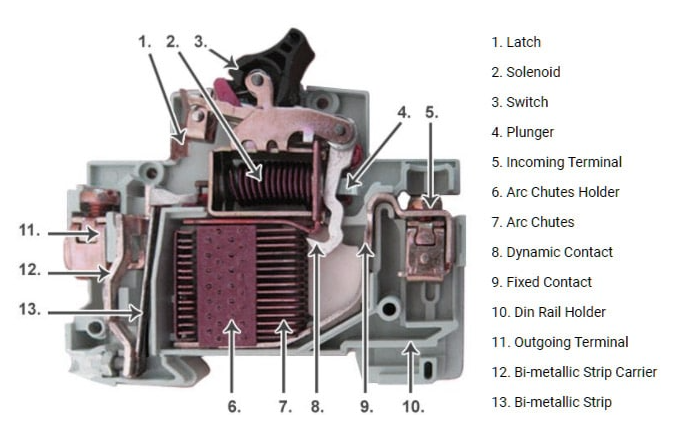
-
Incoming Terminal
The incoming terminal is where the electrical current enters the MCB from the power source, typically connected to the main distribution board. -
Outgoing Terminal
The outgoing terminal is where the current exits the MCB and flows to the connected load or circuit. -
DIN Rail Holder
The DIN rail holder ensures that the MCB is securely mounted onto a DIN rail, which is a standardized rail for mounting electrical components. -
Arc Chutes Holder
This component holds the arc chutes in place, which are designed to extinguish the electrical arc that forms when the MCB switches off the current. -
Arc Chutes
Arc chutes are made of insulating material and work to suppress and extinguish the electric arc when the contacts of the MCB open. -
Fixed Contact
The fixed contact is part of the contact assembly, typically located in the MCB's body. It remains stationary and works in conjunction with the dynamic contact to complete or interrupt the current flow. -
Dynamic Contact
The dynamic contact moves when the MCB trips, disconnecting the flow of electricity. This is the part of the contact system that physically opens and closes. -
Bi-metallic Strip Carrier
The bi-metallic strip carrier holds the bi-metallic strip in place. The bi-metallic strip is the component responsible for the thermal tripping mechanism of the MCB. -
Bi-metallic Strip
The bi-metallic strip bends when exposed to excessive heat caused by an overload current. This bending action triggers the tripping mechanism to disconnect the circuit. -
Latch
The latch is a mechanical component that holds the MCB in the "on" position until an overload or short circuit causes it to trip. It keeps the MCB in place until the trip unit releases it. -
Plunger
The plunger is responsible for interacting with the latch to release it when a fault condition is detected, allowing the MCB to trip. -
Solenoid
A solenoid is used in the magnetic trip mechanism. It generates a magnetic field when excessive current is detected, instantly triggering the tripping action. -
Switch
The switch allows manual operation of the MCB, enabling users to turn the circuit on or off as needed.
Main Contacts:
The main contacts are the core elements that either allow or interrupt the flow of current. They open when the MCB trips and close when the circuit is functioning normally.
Trip Unit:
The trip unit is the heart of the MCB's protection function. It houses the thermal and magnetic components that detect overloads and short circuits.
Terminal:
Terminals are the connection points for the incoming and outgoing electrical conductors. They allow for safe and secure attachment to the electrical circuit.
Housing:
The housing of the MCB is the external casing that holds all the internal components in place, protecting them from external damage and ensuring safety during operation.
Trip Indicator:
The trip indicator is a visual signal that shows when the MCB has tripped, often in the form of a red or orange flag that appears when the MCB switches off due to a fault.
Auxiliary Contacts:
Auxiliary contacts provide additional control options and allow integration with other devices or systems for remote monitoring or additional signaling when the MCB trips.
Trip Spring:
The trip spring is responsible for the physical movement of the contacts when the MCB trips. It stores mechanical energy, which is released when the overload or short circuit condition is detected, causing the contacts to open.
These components work together to ensure the MCB provides reliable and efficient protection for electrical circuits against overloads and short circuits.
Miniature Circuit Breaker Working
MCBs work by detecting fault conditions in an electrical circuit, such as an overload or short circuit. When the current flowing through the circuit exceeds the rated value, the MCB automatically trips to disconnect the power supply, preventing damage to electrical components or fire hazards.
The working mechanism is based on two principles:
-
Thermal Trip: For overload protection, MCBs use a thermal mechanism, where a bimetallic strip bends when it heats up due to prolonged current flow. This action causes the circuit to disconnect.
-
Magnetic Trip: For short circuit protection, the MCB employs a magnetic mechanism. When there is a sudden surge in current, the magnetic field created by the current generates enough force to immediately trip the MCB.
MCB Working Principle
The working principle of an MCB revolves around detecting abnormal current flow and interrupting the power supply. The MCB operates using a thermal mechanism for overload protection and a magnetic mechanism for short circuit protection.
-
Thermal mechanism: The overload current heats up the bimetallic strip inside the MCB. Once the temperature reaches a certain point, the strip bends, causing the MCB to trip and disconnect the circuit.
-
Magnetic mechanism: In the event of a short circuit, a rapid increase in current creates a strong magnetic field. This magnetic force acts on the moving parts of the MCB, causing the contacts to open instantaneously, thus protecting the circuit from further damage.
Miniature Circuit Breaker Types
Miniature Circuit Breakers (MCBs) come in various types, each employing a different mechanism to protect electrical circuits. Below is a breakdown of the main types:
Thermal
Thermal MCBs use a bimetallic strip that heats up and bends when excessive current flows through the circuit. This bending causes the contacts to separate, thereby disconnecting the circuit. They are particularly effective for protecting against prolonged overload conditions.
Magnetic
Magnetic MCBs rely on an electromagnetic coil that generates a strong magnetic force when a high surge of current (such as during a short circuit) passes through. This force triggers the breaker to trip instantly, providing rapid protection from short-circuit events.
Hybrid
Hybrid MCBs combine both thermal and magnetic tripping mechanisms. They offer the dual benefit of detecting gradual overloads (via the thermal element) as well as sudden surges (via the magnetic element), ensuring comprehensive protection for the electrical circuit.
Electronic
Electronic MCBs integrate semiconductor-based technology to detect and respond to fault conditions. These breakers offer more precise control over tripping parameters, allowing for adjustable settings and often enabling remote monitoring and diagnostics for enhanced protection.
Isolation
Isolation MCBs are designed not only to protect against overloads and short circuits but also to provide complete electrical isolation when switched off. This makes them ideal for maintenance purposes, ensuring that the circuit is fully de-energized before work is carried out.
Differential
Differential MCBs monitor the difference between the current entering and leaving the circuit. Any imbalance—indicative of a leakage current or fault—triggers the breaker. This type of MCB is useful in applications where precise current balance is critical for safety.
Residual Current Circuit Breaker (RCCB)
RCCBs, also known as Residual Current Devices (RCDs), detect and interrupt leakage currents that could pose a risk of electric shock or fire. By measuring the imbalance between the live and neutral wires, an RCCB trips when it senses that some current is leaking to earth, ensuring enhanced personal protection and electrical safety.
Each type of MCB offers unique advantages depending on the specific requirements of the electrical system and the level of protection needed.
Different Types of MCBs Used in Electrical Protection Systems
In the context of Miniature Circuit Breakers (MCBs), classifications such as Type A, Type B, Type C, Type D, Type E, and Type F denote specific trip characteristics and protection levels. Each type is designed to handle different load conditions and fault scenarios. Here’s an in-depth look at each type:
Type A
Type A MCBs are designed to react to both conventional AC and pulsating DC fault currents. They are highly sensitive and are typically used in circuits with electronic equipment that may generate a pulsating DC component. Their fast response makes them ideal for protecting sensitive devices that require early fault detection.
Type B
Type B MCBs trip when the current exceeds 3 to 5 times the rated current. They are most commonly found in residential installations and circuits with low inrush currents, such as lighting and socket circuits. Their sensitivity to small fault currents ensures effective protection in environments where abrupt surges are minimal.
Type C
Type C MCBs are engineered to trip at 5 to 10 times the rated current, allowing them to tolerate moderate inrush currents often seen in commercial or light industrial applications. They are suitable for circuits that include motors or transformers, where a temporary surge is normal during startup but should not trigger a fault condition.
Type D
Type D MCBs feature a higher trip threshold, typically between 10 to 20 times the rated current. This capability makes them ideal for circuits with heavy inrush currents, such as those found in industrial settings with large motors, welding equipment, or transformer-fed systems. Their robust design prevents nuisance tripping while still ensuring circuit protection.
Type E
Type E MCBs offer a specialized tripping characteristic that balances sensitivity with robustness. They are tailored for applications that experience a mix of low-level and transient high currents. This versatility makes them suitable for circuits where both rapid fault detection and a degree of tolerance for inrush currents are required.
Type F
Type F MCBs incorporate advanced features, including precise electronic monitoring and rapid tripping mechanisms. They are designed for critical applications where immediate fault detection and response are paramount. With enhanced diagnostic capabilities, Type F breakers can be integrated into smart electrical systems, providing real-time monitoring and improved system reliability.
Each type of MCB is chosen based on the specific electrical environment and load characteristics, ensuring that the right balance of sensitivity and tolerance is achieved for optimal circuit protection.
People Also Ask
1. What is the difference between an MCB and a fuse?
An MCB can be reset after tripping, while a fuse needs to be replaced. MCBs are faster in responding to faults, making them more efficient and reusable compared to fuses.
2. What types of MCBs are available?
MCBs are classified into different types based on their tripping characteristics: Type B, C, D, K, and Z.
3. How do I select the right MCB for my application?
To select the right MCB, consider the rated current, the type of load (e.g., motor or lighting), and the expected inrush currents. It's also essential to factor in the type of protection (overload or short circuit) required for the application.
4. What is the standard current rating for MCBs?
MCBs are available in various current ratings, typically from 1A to 100A or higher, depending on the application and the protection required.
5. What is the difference between a type B and type C MCB?
Type B MCBs trip at 3 to 5 times the rated current, ideal for circuits without inrush currents, while Type C MCBs trip at 5 to 10 times the rated current, suitable for circuits with moderate inrush currents.
6. What is the lifespan of an MCB?
The lifespan of an MCB can vary, but typically, it lasts around 10,000 to 20,000 operations, depending on the quality and usage conditions.
7. Can I replace an MCB myself?
Yes, replacing an MCB is a straightforward task, but it is crucial to ensure that the new MCB matches the specifications of the old one and that the power is turned off before replacing it.
8. How can I test an MCB to see if it is working correctly?
MCBs can be tested using a circuit tester or by manually tripping the MCB. If it does not trip under fault conditions, it may need to be replaced.
In conclusion, a Miniature Circuit Breaker (MCB) is a vital component in modern electrical systems, providing essential protection from overloads and short circuits. Understanding its types, working principles, and proper selection ensures reliable and safe electrical operations across various applications.